Research
Also on Google Scholar.
2026
-
First-Order In-Context Shapley: Scalable Data Auditing for LLM Alignment and Evaluation We score each alignment training record by its first-order in-context influence on similar examples, using only forward passes, to flag label errors in HelpSteer2 and HH-RLHF.

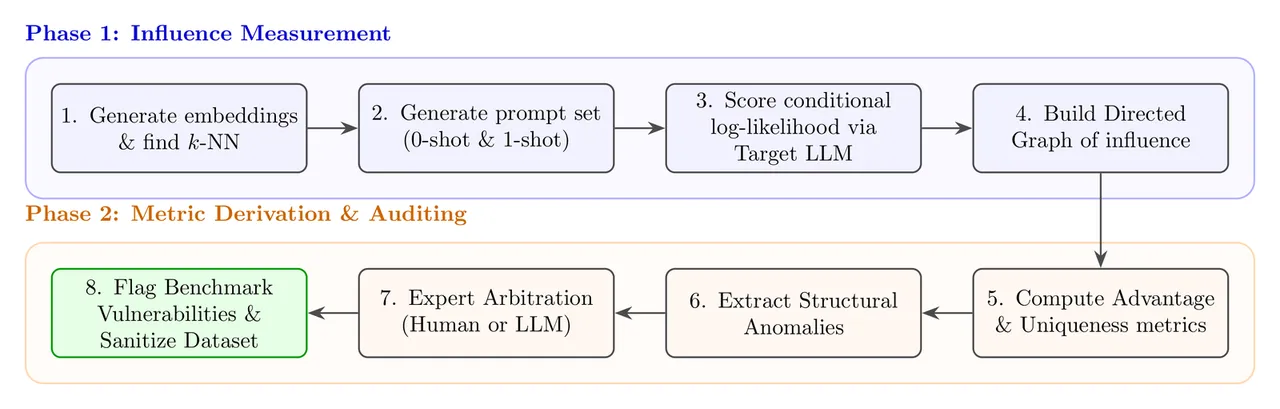
Figure 1. Overview of the data valuation pipeline. Phase 1 constructs a directed k-NN graph weighted by one-shot log-likelihood shifts (ΔLL). Post-training alignment of Large Language Models is increasingly bottlenecked by data quality: preference and instruction-tuning corpora accumulate label noise, safety inversions, and inter-annotator contradictions that deduplication misses and full-corpus LLM judging cannot afford. While Data Shapley offers a principled valuation framework, exact computation requires intractable retraining, and embedding surrogates like KNN-Shapley fail to separate high- from low-utility demonstrations (ρ = 0.0003 with generative utility). We introduce an inference-only valuation pipeline that computes the first-order term of an in-context cooperative game over semantic k-NN neighborhoods in O(k) forward passes without parameter updates, correlating positively with multi-shot Monte-Carlo in-context Shapley on 100% of targets at 19x less compute. Projecting pairwise log-likelihood shifts onto a directed influence graph characterizes each record via three signals: outgoing Exemplifying Advantage, incoming Exemplified Advantage, and a topological One-of-a-Kind Score protecting rare prompts. Pre-filtering restricts LLM twin arbitration to 1%-5% of records while achieving 4.5x enrichment in confirmed errors on HelpSteer2 and 2.2x on Anthropic HH-RLHF, catching contradictions that zero-shot likelihood and margin filters miss. During DPO training, confirmed contradictions oppose the update far more often than clean records (56.7% vs. 37.0% in LoRA gradients) and stay below chance in reward accuracy. Finally, auditing the HH-RLHF benchmark exposes label errors where aligned models disagree with human labels 73%-83% of the time, and retraining DPO after repairing or filtering flagged records improves reward accuracy by +0.5%-0.6% overall and +3.1%-3.5% on repaired inversions, even without LLM arbitration.
2024
-
CALRec: Contrastive Alignment of Generative LLMs for Sequential Recommendation We fine-tune an LLM for sequential recommendation in two stages (multi-domain, then target domain) with contrastive and language-modeling losses, improving Recall@1 by 37% over strong baselines.
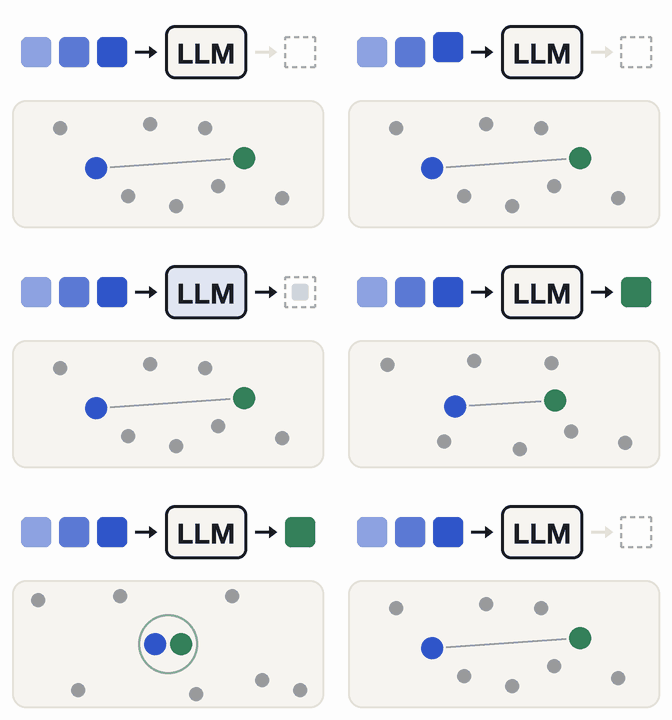
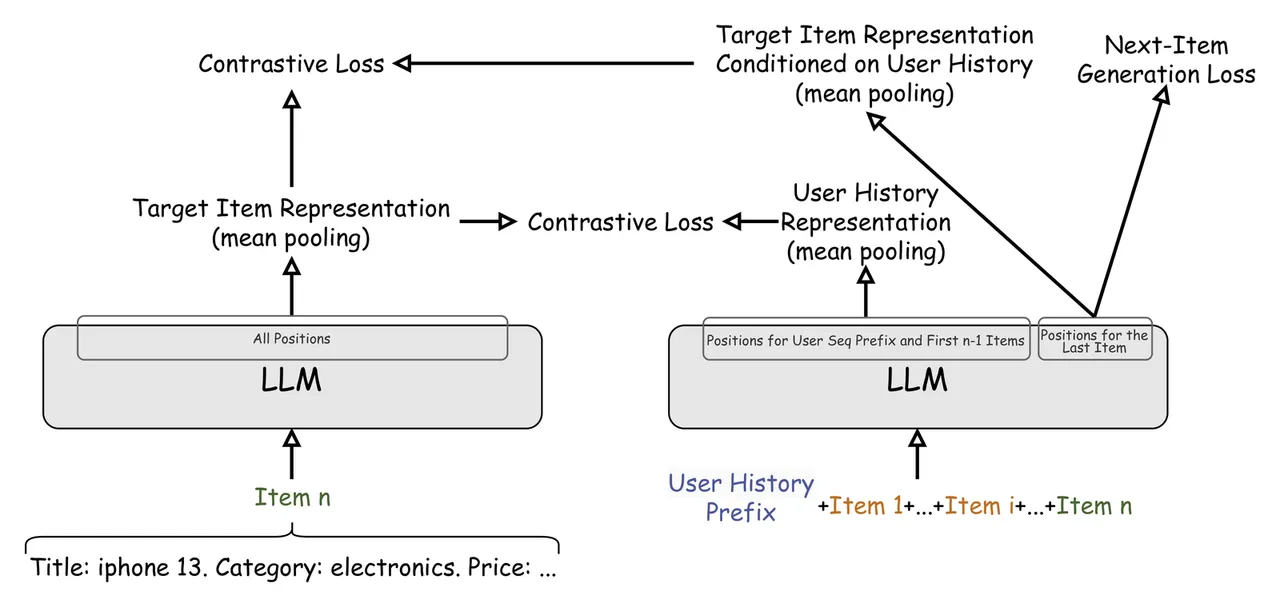
Figure 1. CALRec: Training Framework. Traditional recommender systems such as matrix factorization methods have primarily focused on learning a shared dense embedding space to represent both items and user preferences. Subsequently, sequence models such as RNN, GRUs, and, recently, Transformers have emerged and excelled in the task of sequential recommendation. This task requires understanding the sequential structure present in users' historical interactions to predict the next item they may like. Building upon the success of Large Language Models (LLMs) in a variety of tasks, researchers have recently explored using LLMs that are pretrained on vast corpora of text for sequential recommendation. To use LLMs for sequential recommendation, both the history of user interactions and the model's prediction of the next item are expressed in text form. We propose CALRec, a two-stage LLM finetuning framework that finetunes a pretrained LLM in a two-tower fashion using a mixture of two contrastive losses and a language modeling loss: the LLM is first finetuned on a data mixture from multiple domains followed by another round of target domain finetuning. Our model significantly outperforms many state-of-the-art baselines (+37% in Recall@1 and +24% in NDCG@10) and our systematic ablation studies reveal that (i) both stages of finetuning are crucial, and, when combined, we achieve improved performance, and (ii) contrastive alignment is effective among the target domains explored in our experiments.
2023
-
Multi-Task End-to-End Training Improves Conversational Recommendation A single T5 model trained on ReDIAL plus auxiliary MovieLens tasks handles both dialogue and movie recommendation competitively, and probe studies show the auxiliary knowledge transfers to conversation.
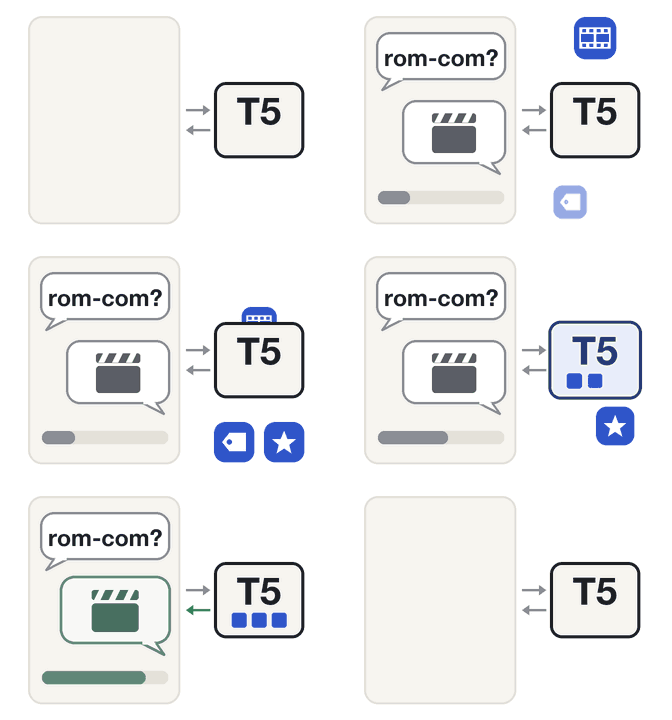
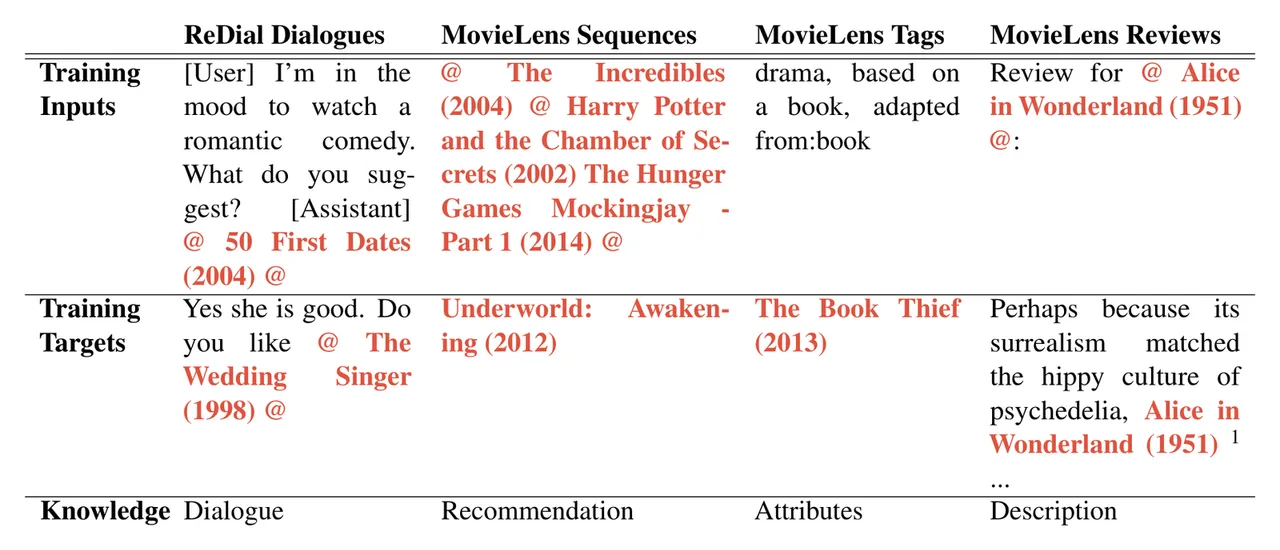
Table 1. Comparison of the primary training task (ReDial Dialogues) and the three auxilary training tasks designed to increase recommendation, attribute, and description knowledge. In this paper, we analyze the performance of a multitask end-to-end transformer model on the task of conversational recommendations, which aim to provide recommendations based on a user's explicit preferences expressed in dialogue. While previous works in this area adopt complex multi-component approaches where the dialogue management and entity recommendation tasks are handled by separate components, we show that a unified transformer model, based on the T5 text-to-text transformer model, can perform competitively in both recommending relevant items and generating conversation dialogue. We fine-tune our model on the ReDIAL conversational movie recommendation dataset, and create additional training tasks derived from MovieLens (such as the prediction of movie attributes and related movies based on an input movie), in a multitask learning setting. Using a series of probe studies, we demonstrate that the learned knowledge in the additional tasks is transferred to the conversational setting, where each task leads to a 9%-52% increase in its related probe score.
2022
-
PhysioGAN: Training High Fidelity Generative Model for Physiological Sensor Readings PhysioGAN, an encoder-decoder-discriminator model, generates synthetic ECG and motion-sensor data realistic enough that classifiers trained only on it lose just 10 to 20% accuracy.
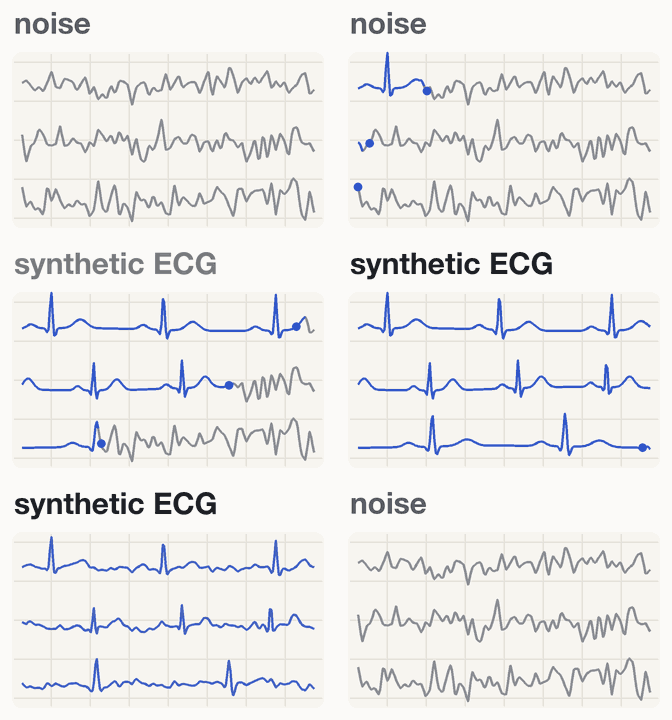
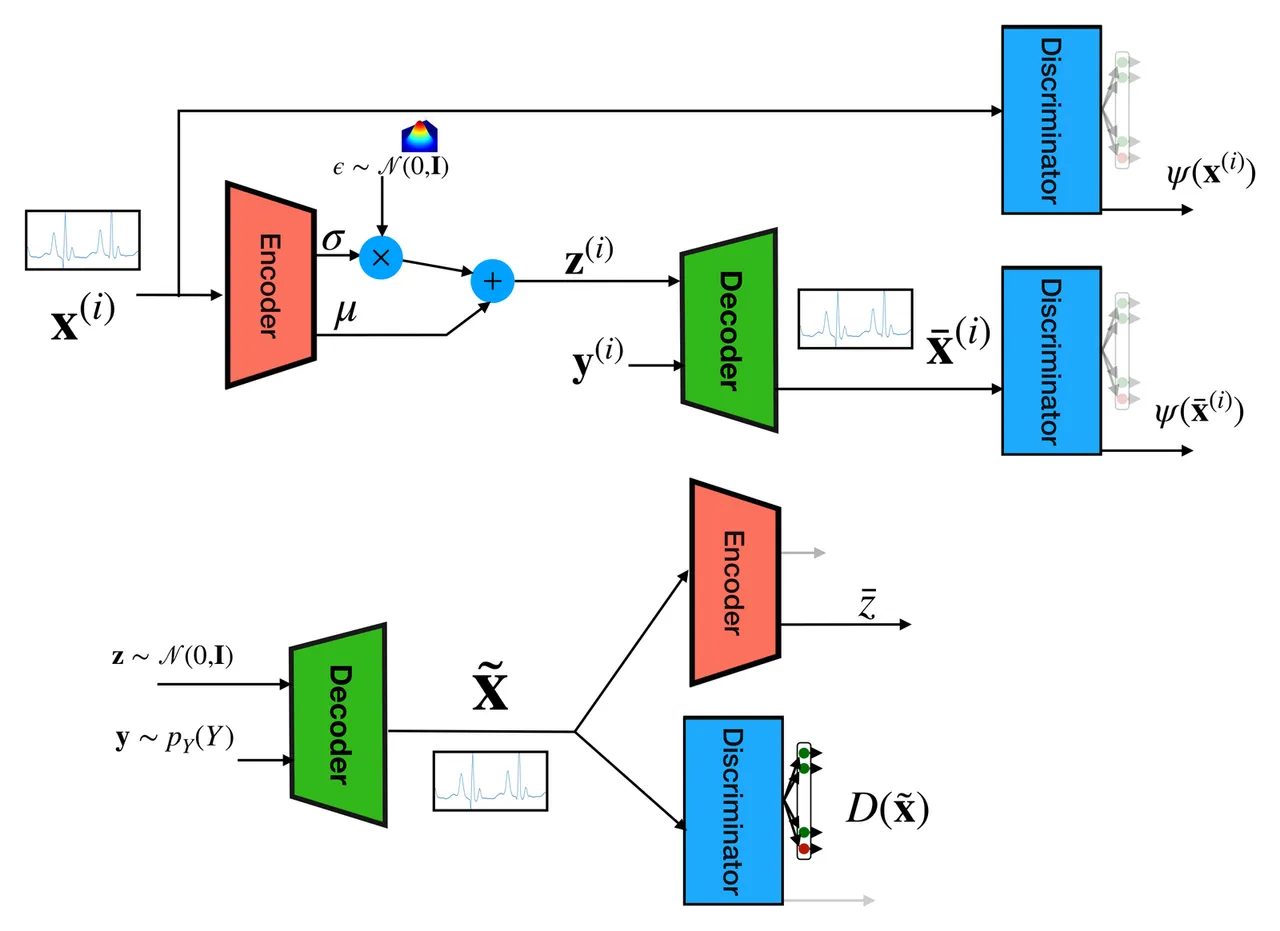
Figure 1. Overview of model design for PhysioGAN. PhysioGAN consist of an encoder, decoder and discriminator components. Generative models such as the variational autoencoder (VAE) and the generative adversarial networks (GAN) have proven to be incredibly powerful for the generation of synthetic data that preserves statistical properties and utility of real-world datasets, especially in the context of image and natural language text. Nevertheless, until now, there has no successful demonstration of how to apply either method for generating useful physiological sensory data. The state-of-the-art techniques in this context have achieved only limited success. We present PHYSIOGAN, a generative model to produce high fidelity synthetic physiological sensor data readings. PHYSIOGAN consists of an encoder, decoder, and a discriminator. We evaluate PHYSIOGAN against the state-of-the-art techniques using two different real-world datasets: ECG classification and activity recognition from motion sensors datasets. We compare PHYSIOGAN to the baseline models not only the accuracy of class conditional generation but also the sample diversity and sample novelty of the synthetic datasets. We prove that PHYSIOGAN generates samples with higher utility than other generative models by showing that classification models trained on only synthetic data generated by PHYSIOGAN have only 10% and 20% decrease in their classification accuracy relative to classification models trained on the real data. Furthermore, we demonstrate the use of PHYSIOGAN for sensor data imputation in creating plausible results.
2021
-
Mondegreen: A Post-Processing Solution to Speech Recognition Error Correction for Voice Search Queries Mondegreen corrects speech recognition errors in voice search queries using only the transcribed text, without audio, and improved user interaction when deployed in a large Google search system.

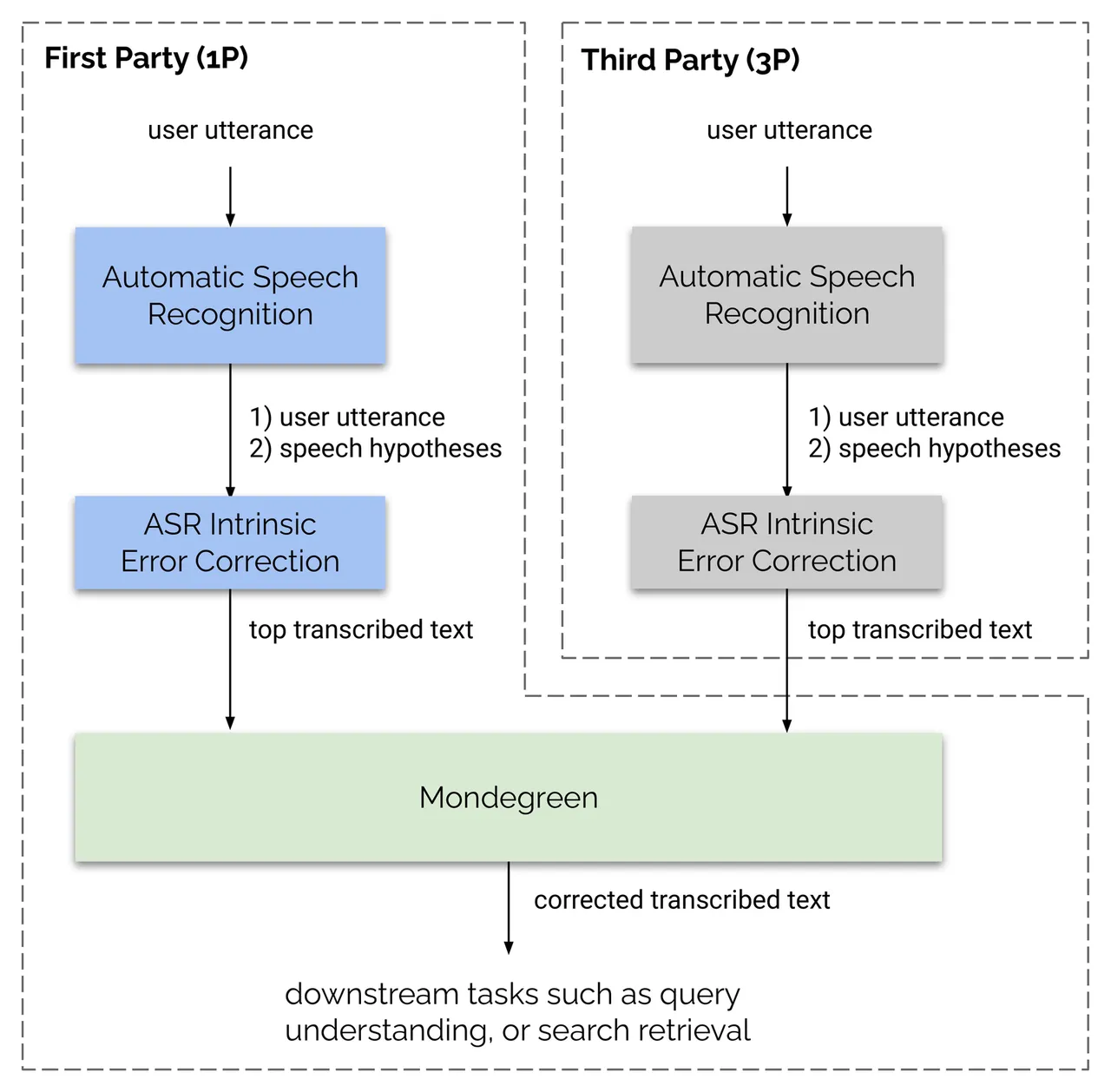
Figure 1. A system diagram showing how Mondegreen can be used with both first-party (1P) and third-party (3P) automatic speech recognition (ASR) systems. User utterance is first transcribed by the 1P or 3P ASR, and then error correction follows. As more and more online search queries come from voice, automatic speech recognition becomes a key component to deliver relevant search results. Errors introduced by automatic speech recognition (ASR) lead to irrelevant search results returned to the user, thus causing user dissatisfaction. In this paper, we introduce an approach, Mondegreen, to correct voice queries in text space without depending on audio signals, which may not always be available due to system constraints or privacy or bandwidth (for example, some ASR systems run on-device) considerations. We focus on voice queries transcribed via several proprietary commercial ASR systems. These queries come from users making internet, or online service search queries. We first present an analysis showing how different the language distribution coming from user voice queries is from that in traditional text corpora used to train off-the-shelf ASR systems. We then demonstrate that Mondegreen can achieve significant improvements in increased user interaction by correcting user voice queries in one of the largest search systems in Google. Finally, we see Mondegreen as complementing existing highly-optimized production ASR systems, which may not be frequently retrained and thus lag behind due to vocabulary drifts.
2019
-
NeuronInspect: Detecting Backdoors in Neural Networks via Output Explanations NeuronInspect detects trojan backdoors by computing output-layer explanation heatmaps, measuring their sparsity, smoothness, and persistence, and flagging outlier classes as attack targets; it outperforms Neural Cleanse.

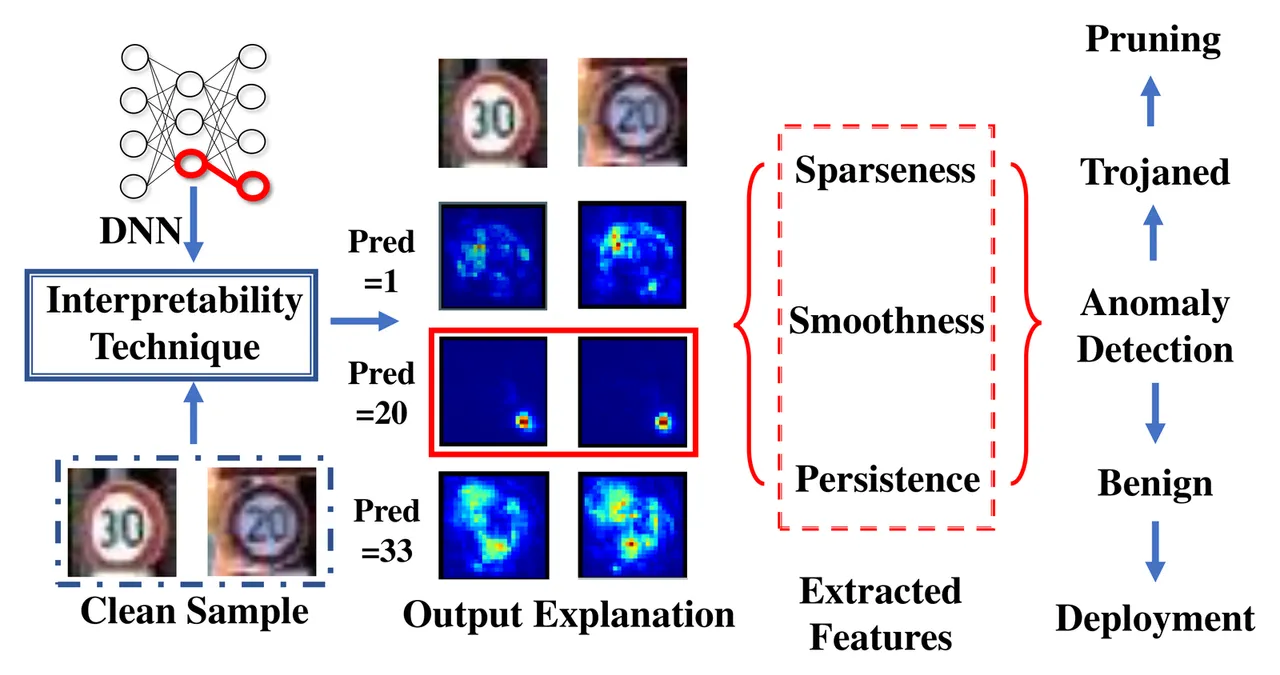
Figure 1. The Processing steps of NeuronInspect for backdoor detection. Explanation heat-maps are generated to explain the classifier output on different clean input images and different output labels. Deep neural networks have achieved state-of-the-art performance on various tasks. However, lack of interpretability and transparency makes it easier for malicious attackers to inject trojan backdoor into the neural networks, which will make the model behave abnormally when a backdoor sample with a specific trigger is input. In this paper, we propose NeuronInspect, a framework to detect trojan backdoors in deep neural networks via output explanation techniques. NeuronInspect first identifies the existence of backdoor attack targets by generating the explanation heatmap of the output layer. We observe that generated heatmaps from clean and backdoored models have different characteristics. Therefore we extract features that measure the attributes of explanations from an attacked model namely: sparse, smooth and persistent. We combine these features and use outlier detection to figure out the outliers, which is the set of attack targets. We demonstrate the effectiveness and efficiency of NeuronInspect on MNIST digit recognition dataset and GTSRB traffic sign recognition dataset. We extensively evaluate NeuronInspect on different attack scenarios and prove better robustness and effectiveness over state-of-the-art trojan backdoor detection techniques Neural Cleanse by a great margin.
-
NeuroMask: Explaining Predictions of Deep Neural Networks through Mask Learning NeuroMask explains an image classifier's prediction by optimizing a mask that keeps the predicted class while hiding irrelevant regions, localizing what drives the decision on CIFAR-10 and ImageNet.

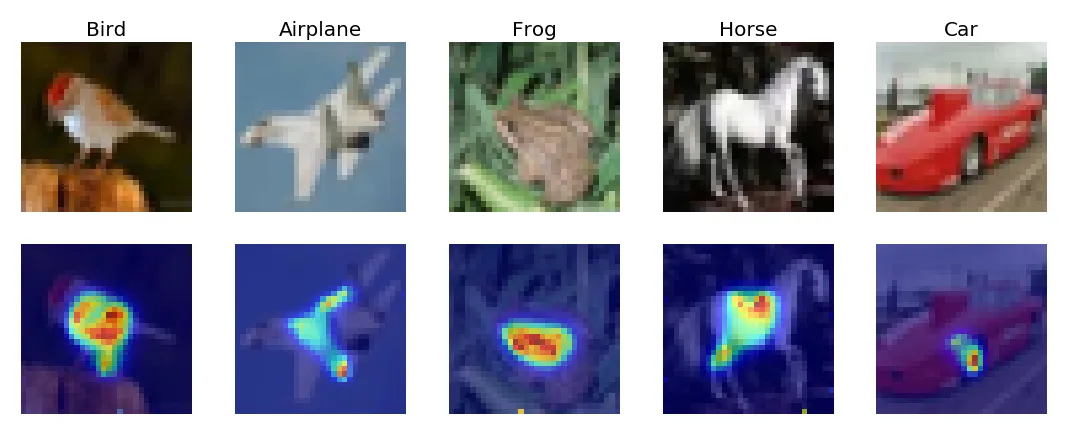
Fig. 2. Using NeuroMask to explain the predictions on a pre-trained model for image recognition on randomly selected examples from the CIFAR-10 dataset. Deep Neural Networks (DNNs) deliver state-of-the-art performance in many image recognition and understanding applications. However, despite their outstanding performance, these models are black-boxes and it is hard to understand how they make their decisions. Over the past few years, researchers have studied the problem of providing explanations of why DNNs predicted their results. However, existing techniques are either obtrusive, requiring changes in model training, or suffer from low output quality. In this paper, we present a novel method, NeuroMask, for generating an interpretable explanation of classification model results. When applied to image classification models, NeuroMask identifies the image parts that are most important to classifier results by applying a mask that hides/reveals different parts of the image, before feeding it back into the model. The mask values are tuned by minimizing a properly designed cost function that preserves the classification result and encourages producing an interpretable mask. Experiments using state-of-the-art Convolutional Neural Networks for image recognition on different datasets (CIFAR-10 and ImageNet) show that NeuroMask successfully localizes the parts of the input image which are most relevant to the DNN decision. By showing a visual quality comparison between NeuroMask explanations and those of other methods, we find NeuroMask to be both accurate and interpretable.
-
GenAttack: Practical Black-box Attacks with Gradient-Free Optimization GenAttack uses a genetic algorithm to craft black-box adversarial images from model queries alone, needing orders of magnitude fewer queries than ZOO and breaking several ImageNet defenses.
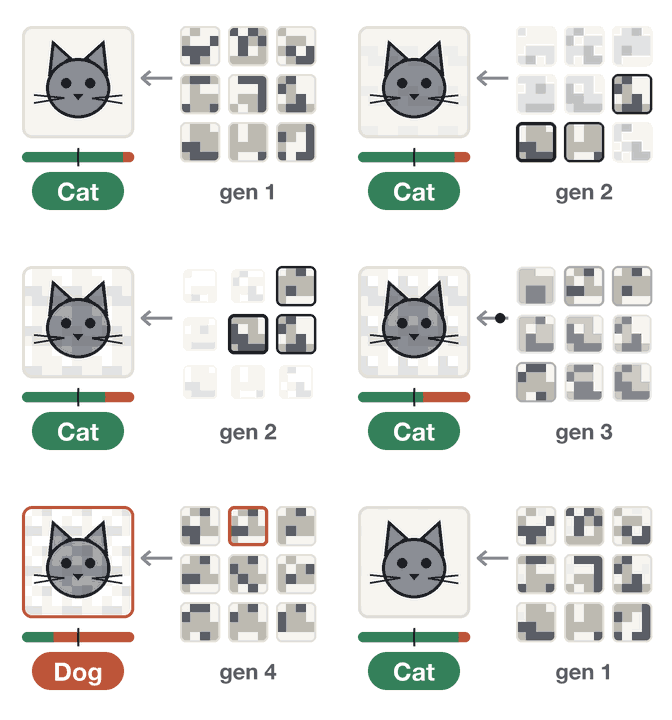
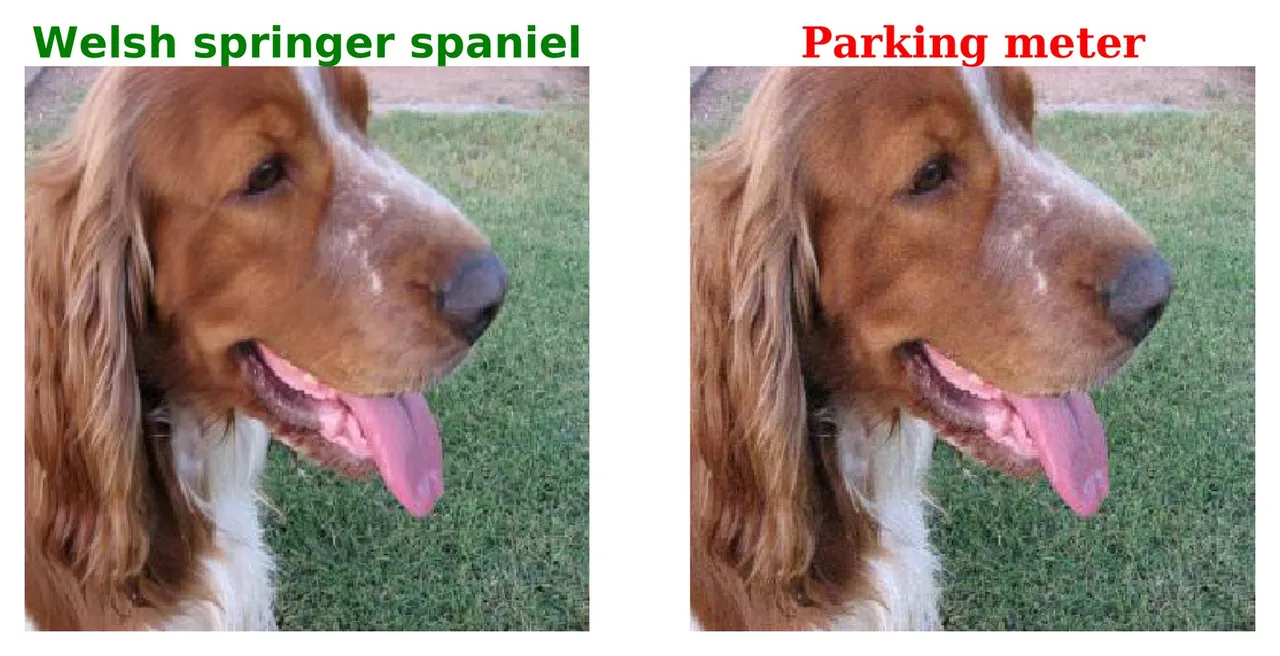
Figure 3. Adversarial example generated by GenAttack against the InceptionV3 model (L∞ = 0.05). Left figure: original, right figure: adversarial example. Deep neural networks are vulnerable to adversarial examples, even in the black-box setting, where the attacker is restricted solely to query access. Existing black-box approaches to generating adversarial examples typically require a significant number of queries, either for training a substitute network or performing gradient estimation. We introduce GenAttack, a gradient-free optimization technique that uses genetic algorithms for synthesizing adversarial examples in the black-box setting. Our experiments on different datasets (MNIST, CIFAR-10, and ImageNet) show that GenAttack can successfully generate visually imperceptible adversarial examples against state-of-the-art image recognition models with orders of magnitude fewer queries than previous approaches. Against MNIST and CIFAR-10 models, GenAttack required roughly 2,126 and 2,568 times fewer queries respectively, than ZOO, the prior state-of-the-art black-box attack. In order to scale up the attack to large-scale high-dimensional ImageNet models, we perform a series of optimizations that further improve the query efficiency of our attack leading to 237 times fewer queries against the Inception-v3 model than ZOO. Furthermore, we show that GenAttack can successfully attack some state-of-the-art ImageNet defenses, including ensemble adversarial training and non-differentiable or randomized input transformations. Our results suggest that evolutionary algorithms open up a promising area of research into effective black-box attacks.
-
Deep Residual Neural Networks for Audio Spoofing Detection Our ASVspoof 2019 entry fuses three residual CNNs over MFCC, STFT, and CQCC features, improving t-DCF and EER over baselines by 25% (logical access) and over 70% (replay).
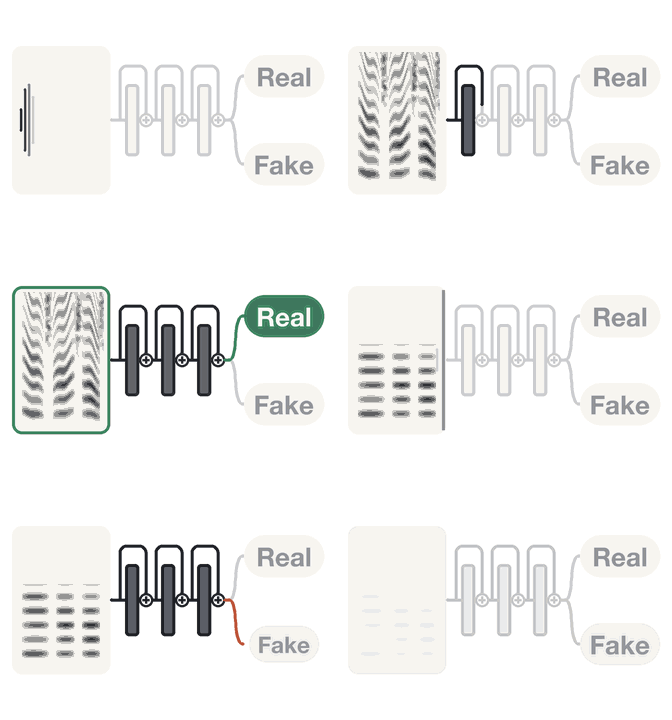
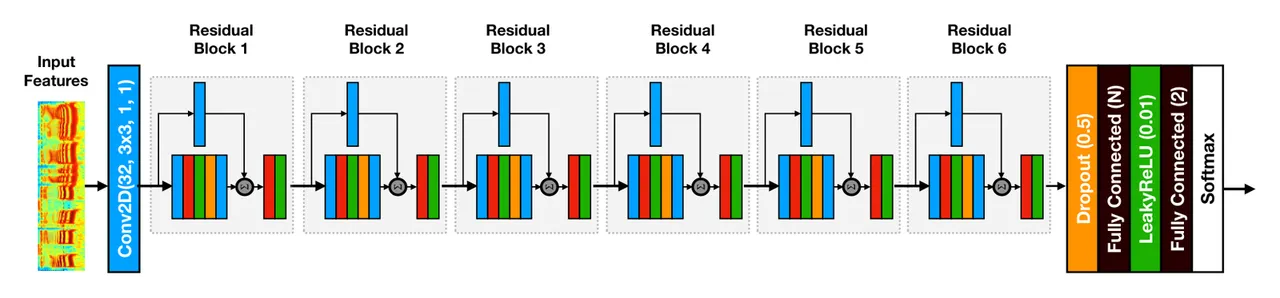
Figure 1. Model architecture for the Spec-ResNet model. The state-of-art models for speech synthesis and voice conversion are capable of generating synthetic speech that is perceptually indistinguishable from bonafide human speech. These methods represent a threat to the automatic speaker verification (ASV) systems. Additionally, replay attacks where the attacker uses a speaker to replay a previously recorded genuine human speech are also possible. We present our solution for the ASVSpoof2019 competition, which aims to develop countermeasure systems that distinguish between spoofing attacks and genuine speeches. Our model is inspired by the success of residual convolutional networks in many classification tasks. We build three variants of a residual convolutional neural network that accept different feature representations (MFCC, Log-magnitude STFT, and CQCC) of input. We compare the performance achieved by our model variants and the competition baseline models. In the logical access scenario, the fusion of our models has zero t-DCF cost and zero equal error rate (EER), as evaluated on the development set. On the evaluation set, our model fusion improves the t-DCF and EER by 25% compared to the baseline algorithms. Against physical access replay attacks, our model fusion improves the baseline algorithms t-DCF and EER scores by 71% and 75% on the evaluation set, respectively.
-
JustWalk: A Crowdsourcing Approach for the Automatic Construction of Indoor Floorplans JustWalk builds indoor floorplans automatically from the smartphone motion traces of people walking through a building, using stairs and elevators as anchors to reset inertial drift.

Mapping and navigation applications are now considered popular services for mobile phones users. However, despite the fact that people spend most of their time indoors, these applications are still limited to indoor spaces due to the lack of large-scale indoor floorplan databases. In this paper, we present JustWalk: a crowd intelligence-based system for the automatic construction of buildings floorplans. JustWalk employs a participatory sensing approach using smartphones that are ubiquitously available with users who visit a building to automatically and transparently construct accurate motion traces. These accurate traces are generated by reducing the errors in the inertial motion traces by using the points of interest in the indoor environment (e.g., elevators and stairs, etc.) for error resetting. The collected traces are then processed by means of different mathematical and image processing techniques to detect the overall floorplan shape as well as higher level semantics such as detecting rooms and corridors shapes along with a variety of points of interest in the environment. In comparison to other approaches, our system depends only on the users walking patterns and motion traces. It does not require any explicit inputs or obtrusive actions (e.g., taking photos). Experimental evaluation of JustWalk using different android phones in three testbeds shows that it achieves high accuracy for the point of interest detection (0.6 percent false positive and 1 percent false negative rates). In addition, the proposed error resetting technique leads to more than 12 times enhancement in the median distance error compared to the state-of-the-art. Moreover, the detailed floorplan can be accurately estimated with a relatively small number of traces. This number is amortized over the number of users visiting the building. Finally, we show that JustWalk has a small energy footprint on cell-phones, and could be generalized to other buildings; highlighting its promise as a ubiquitous indoor mapping service.
2018
-
Generating Natural Language Adversarial Examples A black-box population-based search swaps words for semantically similar ones to fool sentiment and entailment models (97% and 70% success), while human annotators still assign the original labels.
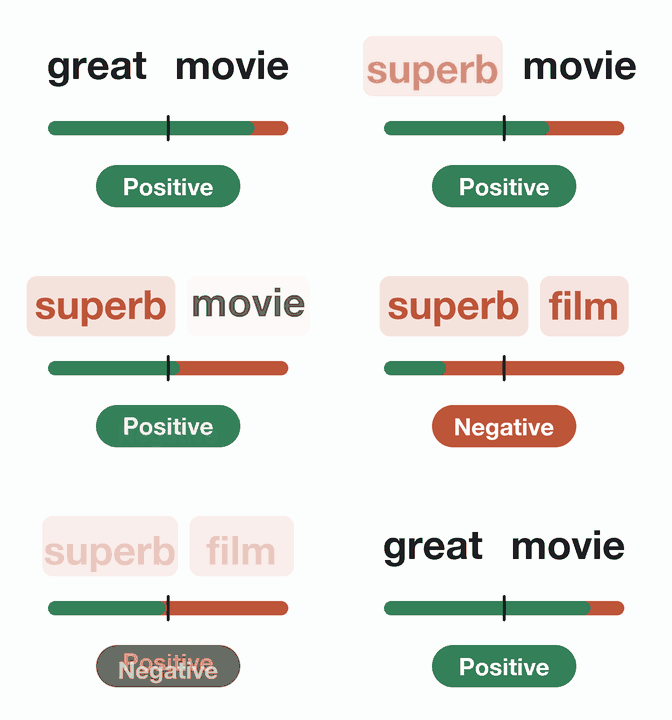
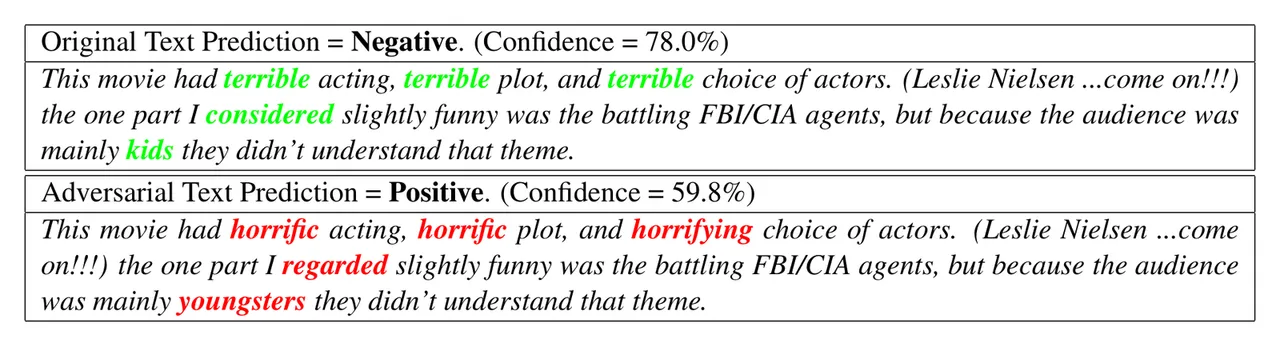
Table 1. Example of attack results for the sentiment analysis task. Modified words are highlighted in green and red for the original and adversarial texts, respectively. Deep neural networks (DNNs) are vulnerable to adversarial examples, perturbations to correctly classified examples which can cause the model to misclassify. In the image domain, these perturbations are often virtually indistinguishable to human perception, causing humans and state-of-the-art models to disagree. However, in the natural language domain, small perturbations are clearly perceptible, and the replacement of a single word can drastically alter the semantics of the document. Given these challenges, we use a black-box population-based optimization algorithm to generate semantically and syntactically similar adversarial examples that fool well-trained sentiment analysis and textual entailment models with success rates of 97% and 70%, respectively. We additionally demonstrate that 92.3% of the successful sentiment analysis adversarial examples are classified to their original label by 20 human annotators, and that the examples are perceptibly quite similar. Finally, we discuss an attempt to use adversarial training as a defense, but fail to yield improvement, demonstrating the strength and diversity of our adversarial examples. We hope our findings encourage researchers to pursue improving the robustness of DNNs in the natural language domain.
-
CAAD 2018: Generating Transferable Adversarial Examples We describe the transferable attack and defense methods behind our CAAD 2018 entries, which placed 1st in both targeted and non-targeted attack tracks and 3rd in defense.
Deep neural networks (DNNs) are vulnerable to adversarial examples, perturbations carefully crafted to fool the targeted DNN, in both the non-targeted and targeted case. In the non-targeted case, the attacker simply aims to induce misclassification. In the targeted case, the attacker aims to induce classification to a specified target class. In addition, it has been observed that strong adversarial examples can transfer to unknown models, yielding a serious security concern. The NIPS 2017 competition was organized to accelerate research in adversarial attacks and defenses, taking place in the realistic setting where submitted adversarial attacks attempt to transfer to submitted defenses. The CAAD 2018 competition took place with nearly identical rules to the NIPS 2017 one. Given the requirement that the NIPS 2017 submissions were to be open-sourced, participants in the CAAD 2018 competition were able to directly build upon previous solutions, and thus improve the state-of-the-art in this setting. Our team participated in the CAAD 2018 competition, and won 1st place in both attack subtracks, non-targeted and targeted adversarial attacks, and 3rd place in defense. We outline our solutions and development results in this article. We hope our results can inform researchers in both generating and defending against adversarial examples.
2017
-
Did You Hear That? Adversarial Examples Against Automatic Speech Recognition We show targeted black-box adversarial attacks on a speech command classifier, reaching 87% success by adding small noise to the least significant bits of audio samples.
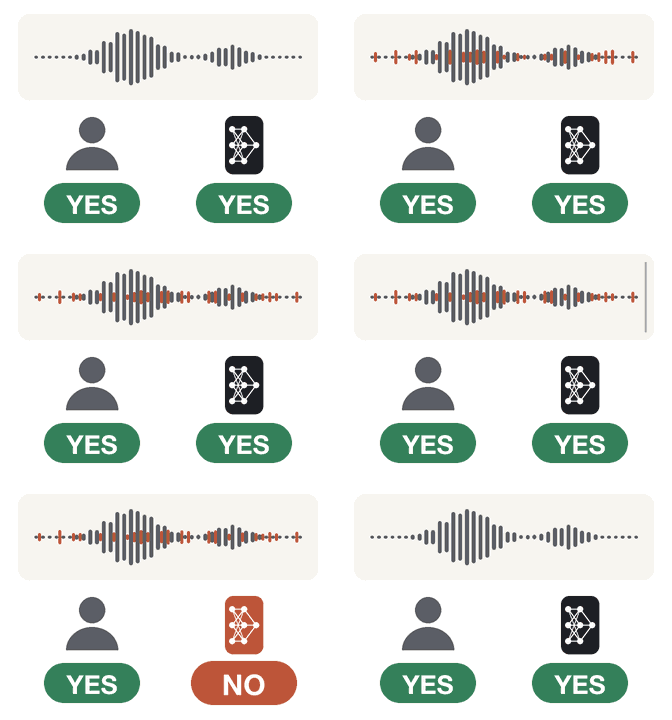
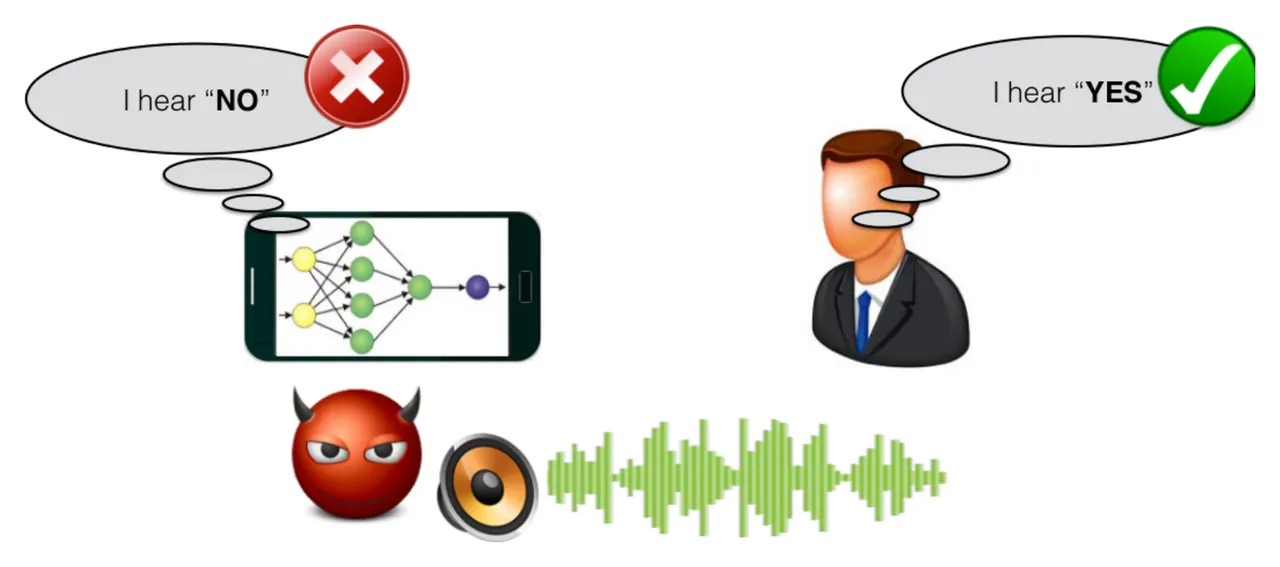
Figure 1. Adversarial attacks on speech commands: a malicious attacker adds small noise to the audio such that it is misclassified by the speech recognition model but does not change human perception. Speech is a common and effective way of communication between humans, and modern consumer devices such as smartphones and home hubs are equipped with deep learning based accurate automatic speech recognition to enable natural interaction between humans and machines. Recently, researchers have demonstrated powerful attacks against machine learning models that can fool them to produce incorrect results. However, nearly all previous research in adversarial attacks has focused on image recognition and object detection models. In this short paper, we present a first of its kind demonstration of adversarial attacks against speech classification model. Our algorithm performs targeted attacks with 87% success by adding small background noise without having to know the underlying model parameter and architecture. Our attack only changes the least significant bits of a subset of audio clip samples, and the noise does not change 89% the human listener's perception of the audio clip as evaluated in our human study.
-
SenseGen: A Deep Learning Architecture for Synthetic Sensor Data Generation SenseGen generates synthetic accelerometer traces with stacked LSTMs and a mixture density network; an LSTM discriminator tells them apart from real data only about 50% of the time.
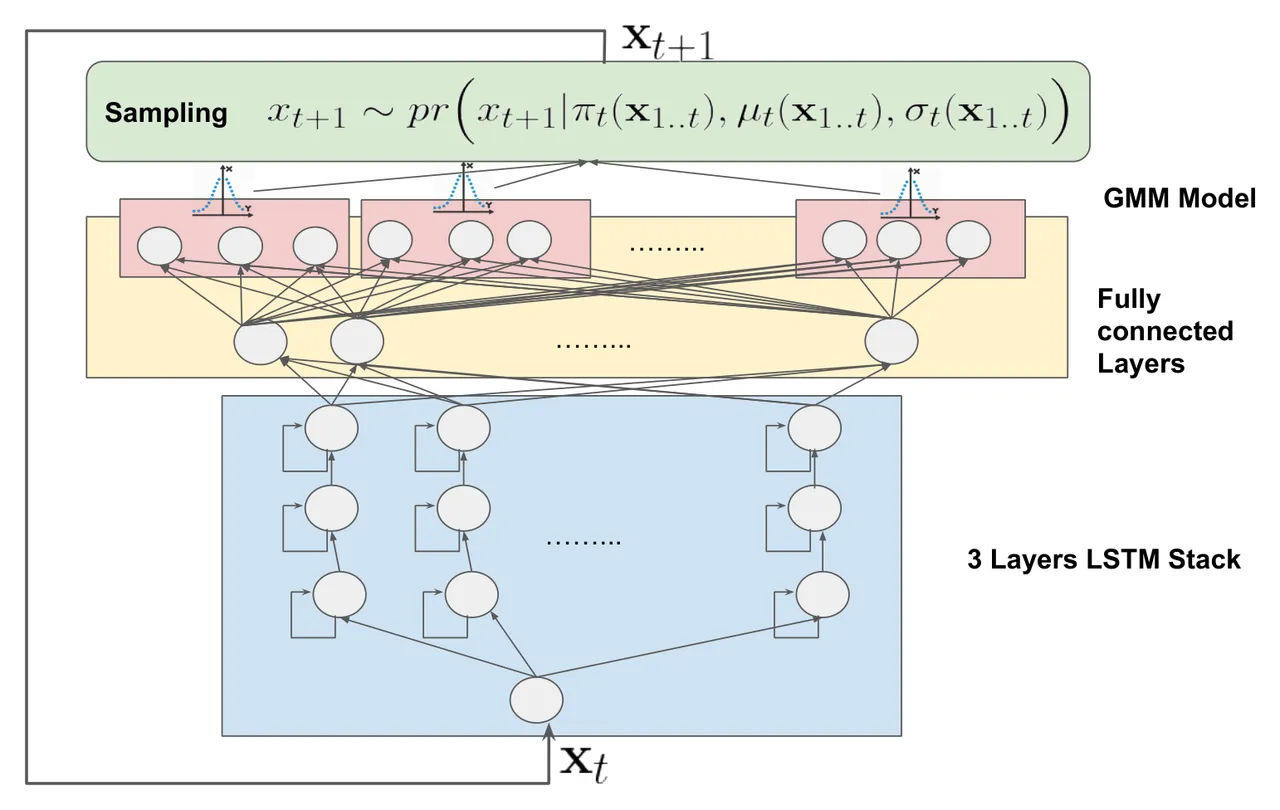
Fig. 1. Generative Model architecture. Our ability to synthesize sensory data that preserves specific statistical properties of the real data has had tremendous implications on data privacy and big data analytics. The synthetic data can be used as a substitute for selective real data segments,that are sensitive to the user, thus protecting privacy and resulting in improved analytics.However, increasingly adversarial roles taken by data recipients such as mobile apps, or other cloud-based analytics services, mandate that the synthetic data, in addition to preserving statistical properties, should also be difficult to distinguish from the real data. Typically, visual inspection has been used as a test to distinguish between datasets. But more recently, sophisticated classifier models (discriminators), corresponding to a set of events, have also been employed to distinguish between synthesized and real data. The model operates on both datasets and the respective event outputs are compared for consistency. In this paper, we take a step towards generating sensory data that can pass a deep learning based discriminator model test, and make two specific contributions: first, we present a deep learning based architecture for synthesizing sensory data. This architecture comprises of a generator model, which is a stack of multiple Long-Short-Term-Memory (LSTM) networks and a Mixture Density Network. second, we use another LSTM network based discriminator model for distinguishing between the true and the synthesized data. Using a dataset of accelerometer traces, collected using smartphones of users doing their daily activities, we show that the deep learning based discriminator model can only distinguish between the real and synthesized traces with an accuracy in the neighborhood of 50%.
-
RSTensorFlow: GPU Enabled TensorFlow for Deep Learning on Commodity Android Devices We extend TensorFlow with RenderScript so deep learning models can use the GPU on commodity Android phones, and find large matrix multiplications run about 3x faster than CPU-only.
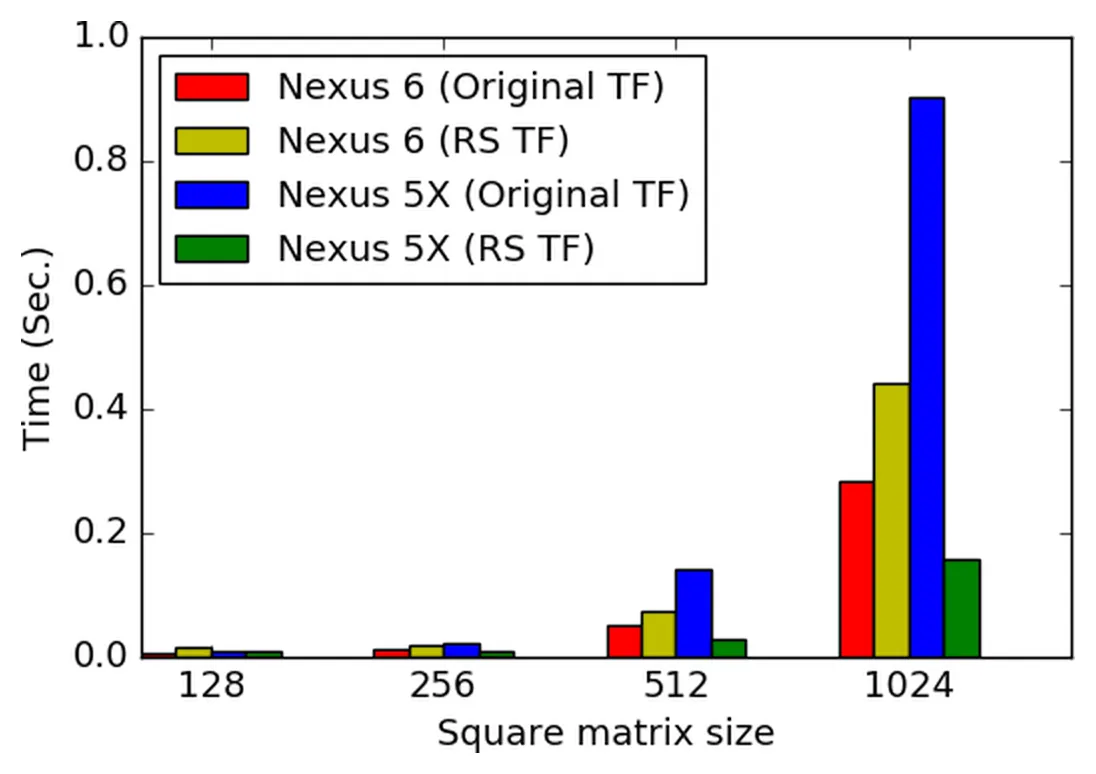
Figure 2. Time of matrix multiplication between square matrices using Original TensorFlow and RenderScript TensorFlow. Mobile devices have become an essential part of our daily lives. By virtue of both their increasing computing power and the recent progress made in AI, mobile devices evolved to act as intelligent assistants in many tasks rather than a mere way of making phone calls. However, popular and commonly used tools and frameworks for machine intelligence are still lacking the ability to make proper use of the available heterogeneous computing resources on mobile devices. In this paper, we study the benefits of utilizing the heterogeneous (CPU and GPU) computing resources available on commodity android devices while running deep learning models. We leveraged the heterogeneous computing framework RenderScript to accelerate the execution of deep learning models on commodity Android devices. Our system is implemented as an extension to the popular open source framework TensorFlow. By integrating our acceleration framework tightly into TensorFlow, machine learning engineers can now easily make benefit of the heterogeneous computing resources on mobile devices without the need of any extra tools. We evaluate our system on different android phones models to study the trade-offs of running different neural network operations on the GPU. We also compare the performance of running different models architectures such as convolutional and recurrent neural networks on CPU only vs using heterogeneous computing resources. Our result shows that although GPUs on the phones are capable of offering substantial performance gain in matrix multiplication on mobile devices. Therefore, models that involve multiplication of large matrices can run much faster (approx. 3 times faster in our experiments) due to GPU support.
-
SeleCon: Scalable IoT Device Selection and Control Using Hand Gestures SeleCon lets users select an IoT device by pointing a UWB-equipped smartwatch at it and control it with air gestures, reaching 84.5% selection and 97% gesture accuracy.
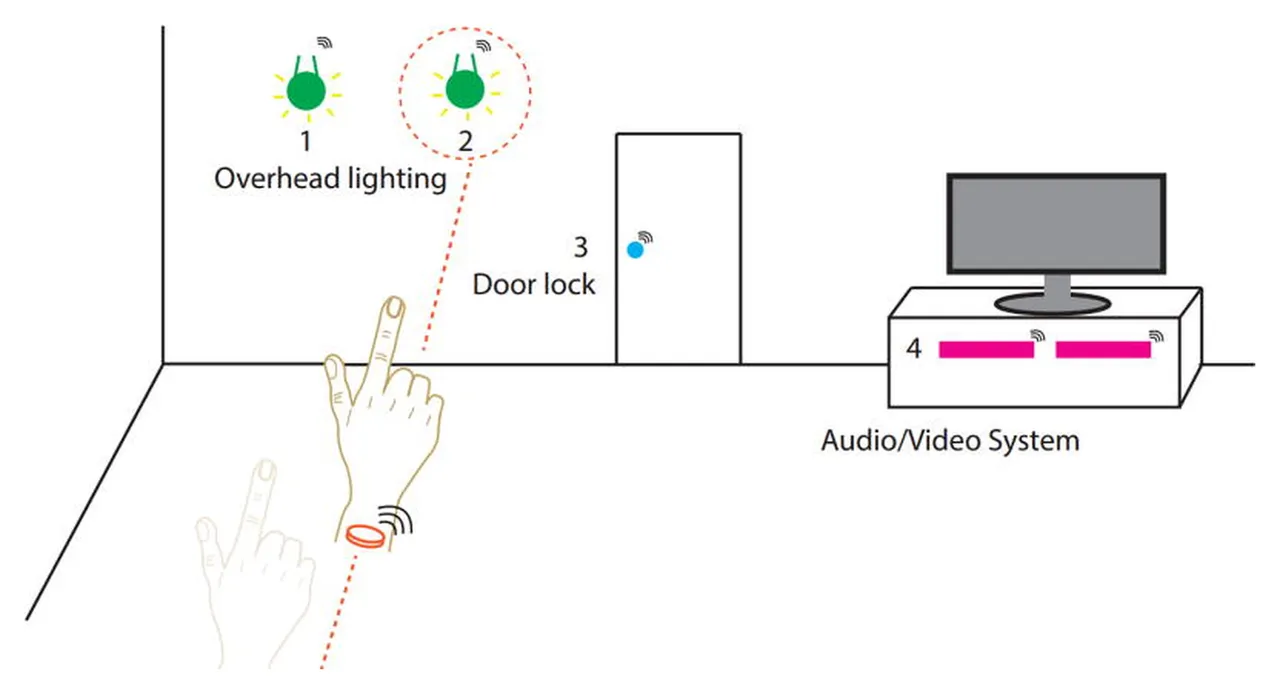
Figure 1. Gesture based IoT device selection using wearable devices. Although different interaction modalities have been proposed in the field of human-computer interface (HCI), only a few of these techniques could reach the end users because of scalability and usability issues. Given the popularity and the growing number of IoT devices, selecting one out of many devices becomes a hurdle in a typical smarthome environment. Therefore, an easy-to-learn, scalable, and non-intrusive interaction modality has to be explored. In this paper, we propose a pointing approach to interact with devices, as pointing is arguably a natural way for device selection. We introduce SeleCon for device selection and control which uses an ultra-wideband (UWB) equipped smartwatch. To interact with a device in our system, people can point to the device to select it then draw a hand gesture in the air to specify a control action. To this end, SeleCon employs inertial sensors for pointing gesture detection and a UWB transceiver for identifying the selected device from ranging measurements. Furthermore, SeleCon supports an alphabet of gestures that can be used for controlling the selected devices. We performed our experiment in a 9m-by-10m lab space with eight deployed devices. The results demonstrate that SeleCon can achieve 84.5% accuracy for device selection and 97% accuracy for hand gesture recognition. We also show that SeleCon is power efficient to sustain daily use by turning off the UWB transceiver, when a user's wrist is stationary.
2016
-
CryptoImg: Privacy Preserving Processing Over Encrypted Images CryptoImg is an OpenCV extension that uses homomorphic encryption to run common image operations, such as filtering and histogram equalization, on encrypted images with small error and overhead.
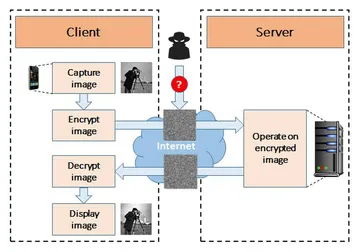
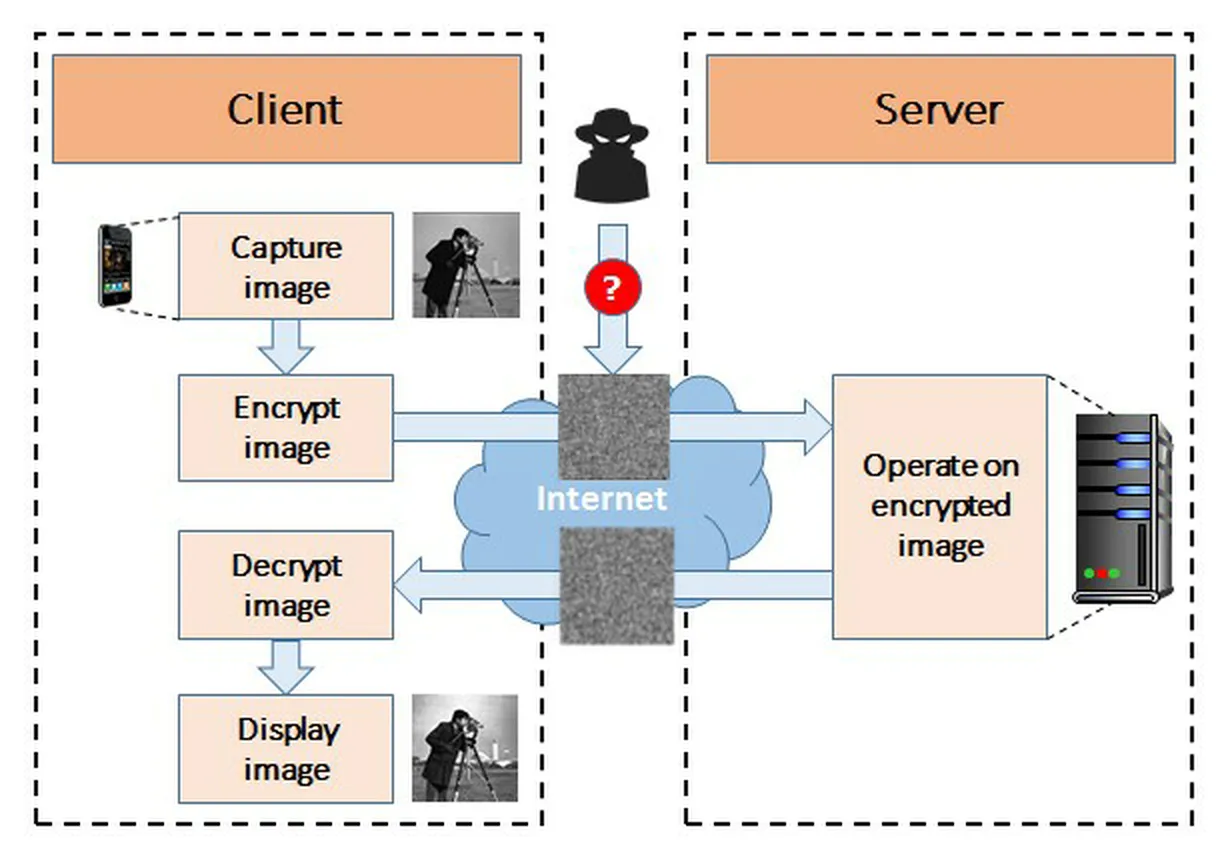
Fig. 1. System Architecture of CryptoImg. Cloud computing services provide a scalable solution for the storage and processing of images and multimedia files. However, concerns about privacy risks prevent users from sharing their personal images with third-party services. In this paper, we describe the design and implementation of CryptoImg, an open source library (Source at https://github.com/TarekIbnZiad/CryptoImg) of modular privacy preserving image processing operations over encrypted images. By using homomorphic encryption, CryptoImg allows the users to delegate their image processing operations to remote servers without any privacy concerns. Currently, CryptoImg supports a subset of the most frequently used image processing operations such as image adjustment, spatial filtering, edge sharpening, histogram equalization and others. We implemented our library as an extension to the popular computer vision library OpenCV. CryptoImg can be used from either mobile or desktop clients. Our experimental results demonstrate that CryptoImg is efficient while performing operations over encrypted images with negligible error and reasonable time overheads on the supported platforms.
-
SemanticSLAM: Using Environment Landmarks for Unsupervised Indoor Localization SemanticSLAM treats spots with distinctive phone-sensor signatures as landmarks and fuses them with dead reckoning in a SLAM framework, reaching 0.53 m median localization error without war-driving.
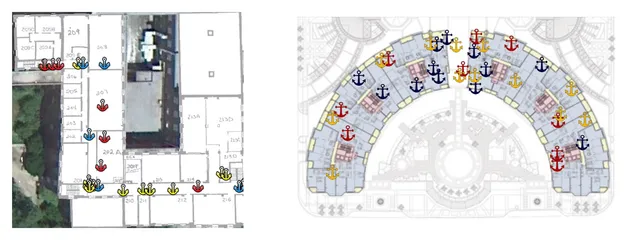
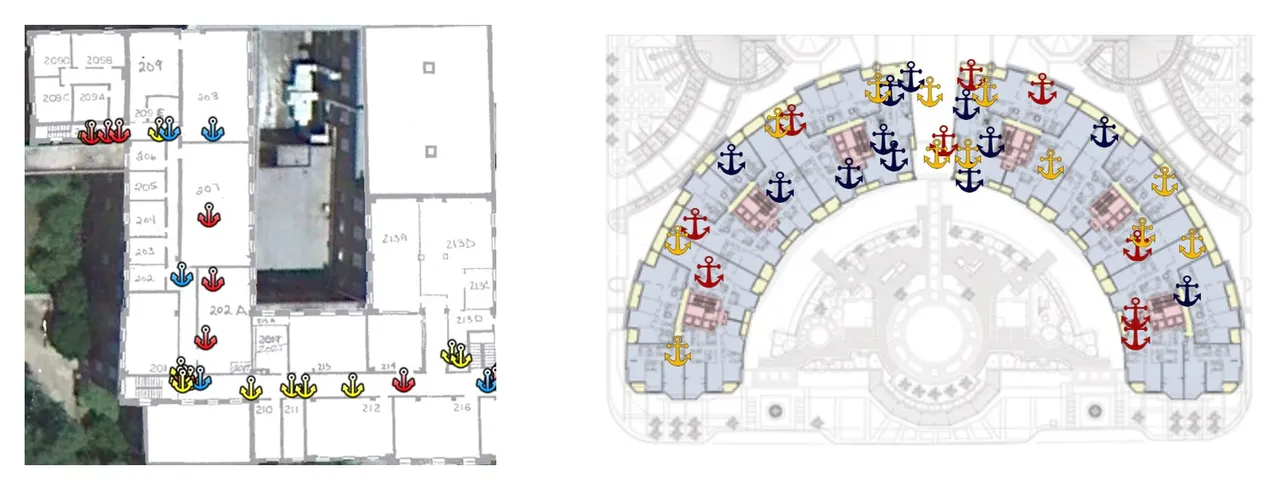
Fig. 8. Testbeds used in the evaluation. The blue, red and yellow anchors are the inertial, magnetic, and WiFi landmarks respectively. Indoor localization using mobile sensors has gained momentum lately. Most of the current systems rely on an extensive calibration step to achieve high accuracy. We propose SemanticSLAM, a novel unsupervised indoor localization scheme that bypasses the need for war-driving. SemanticSLAM leverages the idea that certain locations in an indoor environment have a unique signature on one or more phone sensors. Climbing stairs, for example, has a distinct pattern on the phone's accelerometer; a specific spot may experience an unusual magnetic interference while another may have a unique set of Wi-Fi access points covering it. SemanticSLAM uses these unique points in the environment as landmarks and combines them with dead-reckoning in a new Simultaneous Localization And Mapping (SLAM) framework to reduce both the localization error and convergence time. In particular, the phone inertial sensors are used to keep track of the user's path, while the observed landmarks are used to compensate for the accumulation of error in a unified probabilistic framework. Evaluation in two testbeds on Android phones shows that the system can achieve 0.53 meters human median localization errors. In addition, the system can detect the location of landmarks with 0.83 meters median error. This is 62 percent better than a system that does not use SLAM. Moreover, SemanticSLAM has a 33 percent lower convergence time compared to the same systems. This highlights the promise of SemanticSLAM as an unconventional approach for indoor localization.
2012
-
No Need to War-Drive: Unsupervised Indoor Localization UnLoc localizes phones indoors without war-driving or floorplans by recalibrating dead reckoning at natural sensor landmarks such as elevators and WiFi signatures, achieving 1.69 m median error.
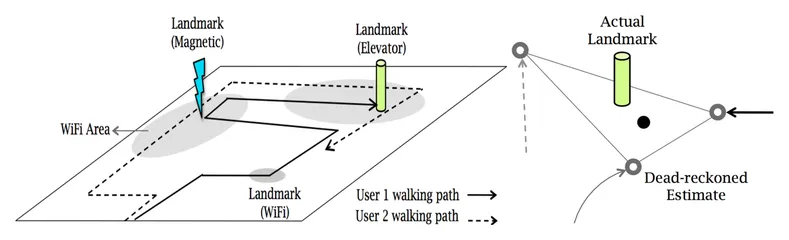
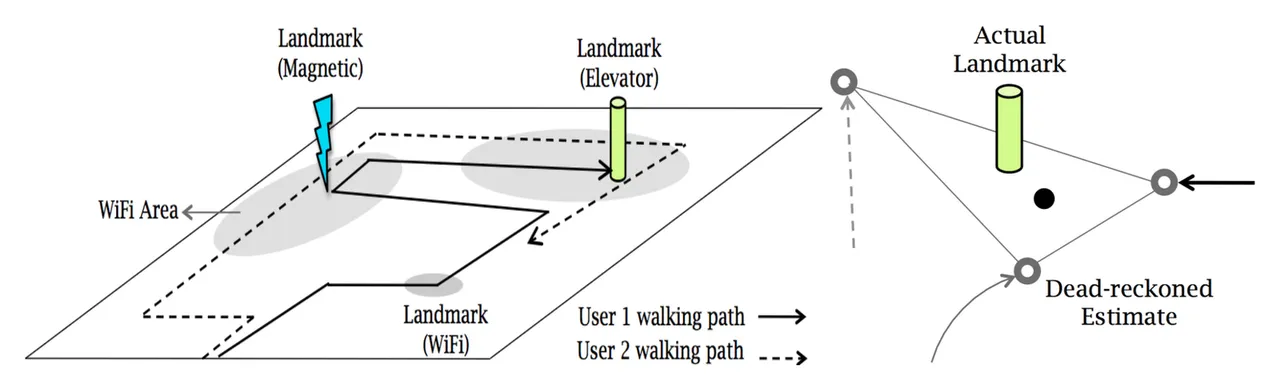
Figure 6. (a) UnLoc users walk and periodically encounter landmarks – refines landmark locations, corrects own location. (b) The solid circle showing the centroid of the dead-reckoned estimates. We propose UnLoc, an unsupervised indoor localization scheme that bypasses the need for war-driving. Our key observation is that certain locations in an indoor environment present identifiable signatures on one or more sensing dimensions. An elevator, for instance, imposes a distinct pattern on a smartphone's accelerometer; a corridor-corner may overhear a unique set of WiFi access points; a specific spot may experience an unusual magnetic fluctuation. We hypothesize that these kind of signatures naturally exist in the environment, and can be envisioned as internal landmarks of a building. Mobile devices that "sense" these landmarks can recalibrate their locations, while dead-reckoning schemes can track them between landmarks. Results from 3 different indoor settings, including a shopping mall, demonstrate median location errors of 1.69m. War-driving is not necessary, neither are floorplans; the system simultaneously computes the locations of users and landmarks, in a manner that they converge reasonably quickly. We believe this is an unconventional approach to indoor localization, holding promise for real-world deployment.
-
CrowdInside: Automatic Construction of Indoor Floorplans CrowdInside reconstructs building floorplans from crowdsourced smartphone motion traces, using stairs and elevators to reset inertial errors, then extracts rooms, corridors, and points of interest.
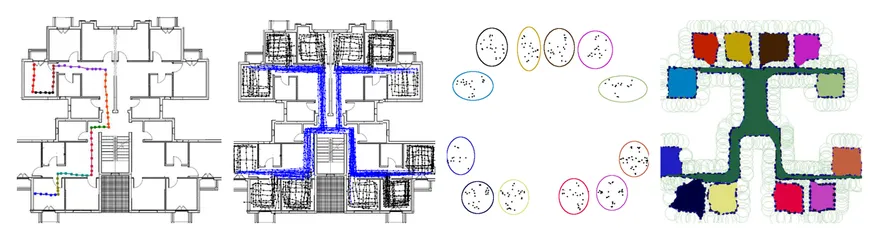
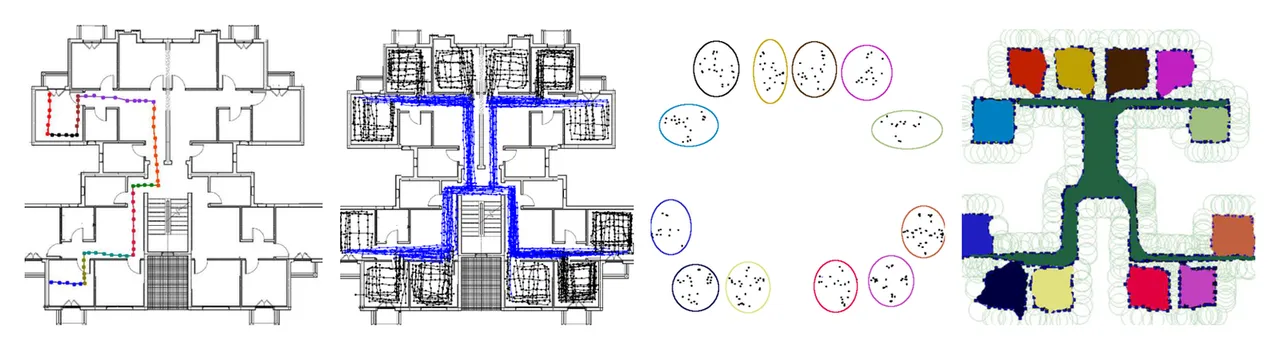
Figure 14. Construction of a detailed floorplan using multiple motion traces. The existence of a worldwide indoor floorplans database can lead to significant growth in location-based applications, especially for indoor environments. In this paper, we present CrowdInside: a crowdsourcing-based system for the automatic construction of buildings floorplans. CrowdInside leverages the smart phones sensors that are ubiquitously available with humans who use a building to automatically and transparently construct accurate motion traces. These accurate traces are generated based on a novel technique for reducing the errors in the inertial motion traces by using the points of interest in the indoor environment, such as elevators and stairs, for error resetting. The collected traces are then processed to detect the overall floorplan shape as well as higher level semantics such as detecting rooms and corridors shapes along with a variety of points of interest in the environment. Implementation of the system in two testbeds, using different Android phones, shows that CrowdInside can detect the points of interest accurately with 0.2% false positive rate and 1.3% false negative rate. In addition, the proposed error resetting technique leads to more than 12 times enhancement in the median distance error compared to the state-of-the-art. Moreover, the detailed floorplan can be accurately estimated with a a relatively small number of traces. This number is amortized over the number of users of the building. We also discuss possible extensions to CrowdInside for inferring even higher level semantics about the discovered floorplans.
-
UPTIME: Ubiquitous Pedestrian Tracking using Mobile Phones UPTIME tracks pedestrians using only phone inertial sensors, combining a finite-state-machine step counter with an SVM gait classifier for stride length, for 6.9% tracking error.
The mission of tracking a pedestrian is valuable for many applications including walking distance estimation for the purpose of pervasive healthcare, museum and shopping mall guides, and locating emergency responders. In this paper, we show how accurate and ubiquitous tracking of a pedestrian can be performed using only the inertial sensors embedded in his/her mobile phone. Our work depends on performing dead reckoning to track the user's movement. The main challenge that needs to be addressed is handling the noise of the low cost low quality inertial sensors in cell phones. Our proposed system combines two novel contributions: a novel step count estimation technique and a gait-based accurate variable step size detection algorithm. The step count estimation technique is based on a lightweight finite state machine approach that leverages orientation-independent features. In order to capture the varying stride length of the user, based on his changing gait, we employ a multi-class hierarchical Support Vector Machine classifier. Combining the estimated number of steps with the an accurate estimate of the individual stride length, we achieve ubiquitous and accurate tracking of a person in indoor environments. We implement our system on different Android-based phones and compare it to the state-of-the-art techniques in indoor and outdoor testbeds with arbitrary phone orientation. Our results in two different testbeds show that we can provide an accurate step count estimation with an error of 5.72%. In addition, our gait type classifier has an accuracy of 97.74%. This leads to a combined tracking error of 6.9% while depending only on the inertial sensors and turning off the GPS sensor completely. This highlights the ability of the system to provide ubiquitous, accurate, and energy efficient tracking.
Patents
Invited talks
Awards
- Google Android Security Award. Responsible disclosure of an Android OS vulnerability.
- 1st place — CAAD 2018 adversarial attack competition. Both attack tracks (targeted and non-targeted); 3rd in defense.
- 5th place — NIST Differential Privacy Synthetic Data Challenge. A differentially private GAN approach to synthetic data.
- 1st place — NeurIPS Adversarial Attacks & Defenses Competition, round 2. Targeted attack track.
- UCLA Graduate Division Fellowship. Awarded three times.
- COMESA Innovation Award. Common Market for Eastern & Southern Africa.
- Featured in MIT Technology Review. Crowdsourced indoor maps and localization.
- Featured in Scientific American. Crowdsourced indoor maps and localization.